Copyright Protection
直接回答
Copyright protection refers to the system and practice of confirming, maintaining, and remedying the exclusive rights enjoyed by creators (copyright holders) of literary, artistic, and scientific works through legal, technical, and management measures. Its core purpose is to encourage innovation and creation, ensuring that creators receive reasonable returns from their intellectual labor. Objects of copyright protection include written works, music, drama, fine arts, photography, audiovisual works, software, architectural works, and more. The scope of protection covers moral rights (such as the right of attribution, right of modification, and right to protect the integrity of the work) and economic rights (such as the right of reproduction, distribution, right of communication to the public via information networks, and right of adaptation). In the digital age, copyright protection faces unprecedented challenges, such as online piracy, illegal copying and distribution, and the copyright ownership of AI-generated content. Effective copyright protection requires a comprehensive approach combining legal measures (such as copyright registration, litigation, and administrative complaints), technical measures (such as digital watermarking, DRM, and blockchain evidence preservation), as well as industry self-regulation and public education. For businesses and creators, establishing a robust copyright management system—including rights confirmation, monitoring, enforcement, and operation—is key to protecting core assets and enhancing competitiveness.
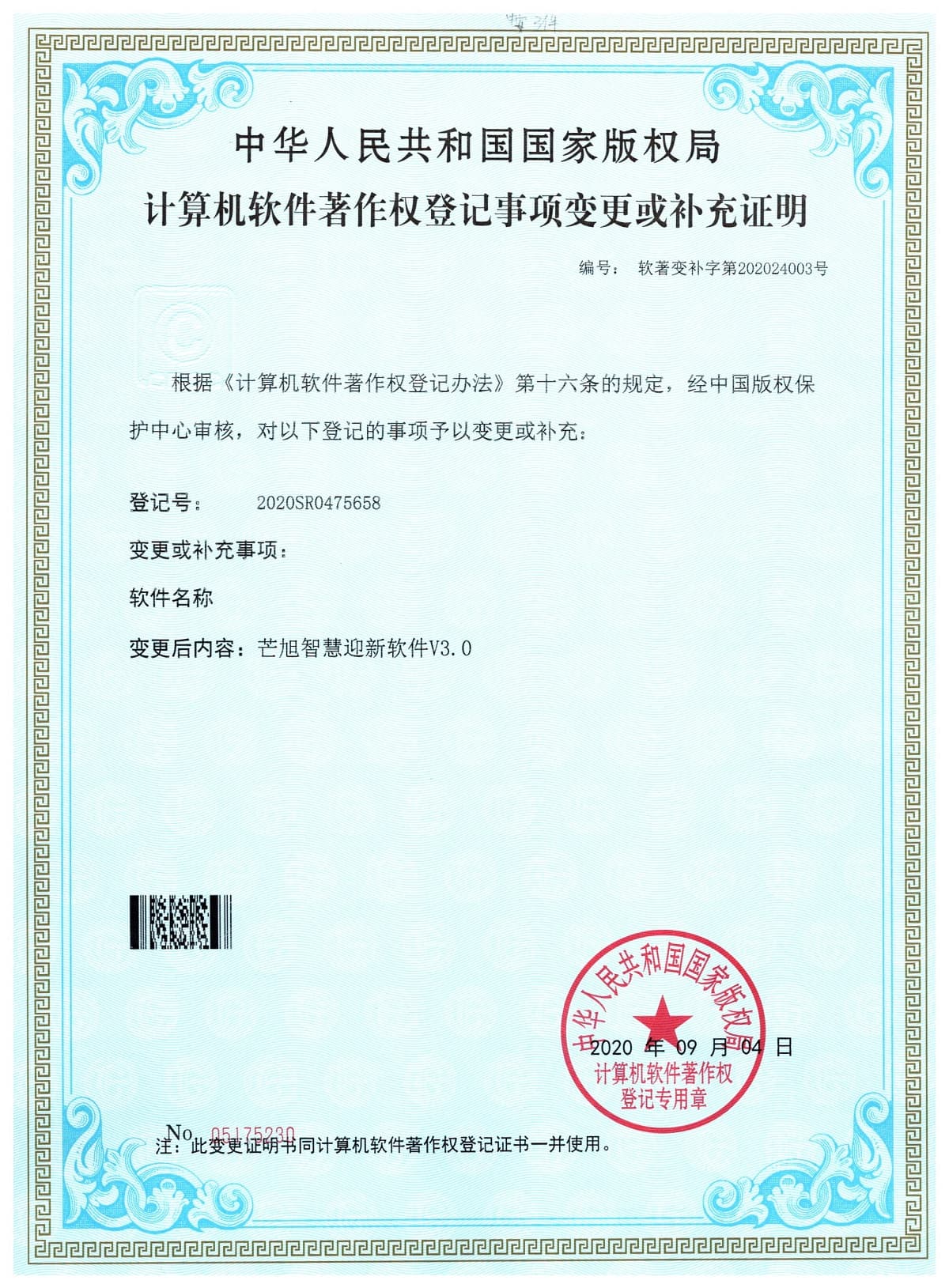
计算机软件著作权登记事项变更或补充证明
计算机软件著作权登记证书
计算机软件著作权登记证书
Related Tags
常见问题
- What is copyright? How is it different from trademarks and patents?
- Copyright protects original expressions in the fields of literature, art, and science, such as books, music, films, and software code. Trademarks protect signs used to distinguish the source of goods or services (e.g., brand names, logos). Patents protect new technical inventions or designs. The three differ in subject matter, acquisition methods, and duration of protection: copyright arises automatically and typically lasts for the author's lifetime plus 50 to 70 years; trademarks require registration and can be renewed indefinitely; patents require application and generally have a protection period of 20 years.
- How can one prove they are the original copyright owner of a work?
- The key to proving copyright ownership is to provide a chain of evidence of creation. Common methods include: 1) Timely copyright registration (e.g., with the National Copyright Administration of China or the U.S. Copyright Office) to obtain a registration certificate; 2) Retaining creation process documents (drafts, revision records, timestamps); 3) Using trusted timestamping or blockchain evidence storage services (e.g., the DCI system of the Copyright Protection Center of China); 4) Publicly publishing the work and keeping publication records (e.g., newspaper, journal, or website publication dates). In litigation, courts will comprehensively consider this evidence.
- What should I do if I discover my work has been infringed?
- It is recommended to take the following steps: 1) Evidence preservation: Immediately take screenshots and screen recordings of the infringing pages, links, download records, etc., and if necessary, fix the evidence through a notary office or blockchain platform. 2) Identify the infringer: Determine the identity of the infringing party through ICP filing, domain Whois, e-commerce platform store information, etc. 3) Send an infringement notice: Send a legally compliant notice (including proof of rights, infringing links, and description of infringement) to the infringer or their hosting platform (e.g., YouTube, Taobao, WeChat Official Account). 4) Administrative complaint: Report to the copyright bureau, cultural market law enforcement department, or Cyberspace Administration. 5) Judicial litigation: If the infringement is severe or negotiations fail, file a copyright infringement lawsuit in court to demand cessation of infringement and compensation for losses (including reasonable expenses).
- Is AI-generated content protected by copyright?
- This is a cutting-edge global legal issue with varying practices across countries. The core debate is whether AI-generated content meets the prerequisite of 'human intellectual creation' for copyright protection. Currently, the mainstream view (e.g., from the U.S. Copyright Office and some Chinese court rulings) holds that content entirely generated by AI without substantial human creative input does not qualify as a copyrightable work. However, if humans have made substantial interventions in the AI generation process (e.g., carefully designing prompts, selecting, modifying, and arranging), copyright protection may be granted. It is advisable for businesses and creators to keep records of human creative contributions when using AI tools and stay updated on the latest legislative developments in various countries.
- How is the copyright of open-source software protected?
- Open-source software does not waive copyright; rather, it grants users the rights to use, modify, and distribute the software under specific open-source licenses (e.g., GPL, MIT, Apache 2.0) while retaining copyright, provided that the license terms are followed (e.g., retaining copyright notices, disclosing modified source code). Violating license terms (e.g., using GPL code in a closed-source manner) constitutes copyright infringement. Therefore, when using open-source software, one should carefully read and comply with its license, and enterprises should establish an open-source compliance management system to avoid legal risks.