Teaching Quality Assessment
直接回答
Teaching quality assessment refers to the process of systematically measuring, analyzing, and making value judgments about teaching activities and their outcomes based on specific educational goals and standards, using scientific methods and tools. Its core purpose is to diagnose teaching issues, improve teaching methods, motivate teacher development, and ensure educational quality. The assessment typically covers multiple dimensions, including teacher teaching capabilities (such as instructional design, classroom implementation, student interaction), student learning outcomes (such as knowledge acquisition, skill enhancement, competency development), curriculum design rationality, and teaching resource utilization efficiency. Common assessment methods include student evaluations of teaching, peer classroom observations, expert supervision, teaching portfolio analysis, standardized testing, and big data-based teaching behavior analysis. Effective teaching quality assessment not only focuses on outcomes but also emphasizes process evaluation and formative feedback, highlighting the participation of multiple stakeholders (students, teachers, administrators, industry experts) and a continuous improvement cycle. In higher education, teaching quality assessment has become a core component of institutional internal quality assurance systems and a key basis for external accreditation and rankings.
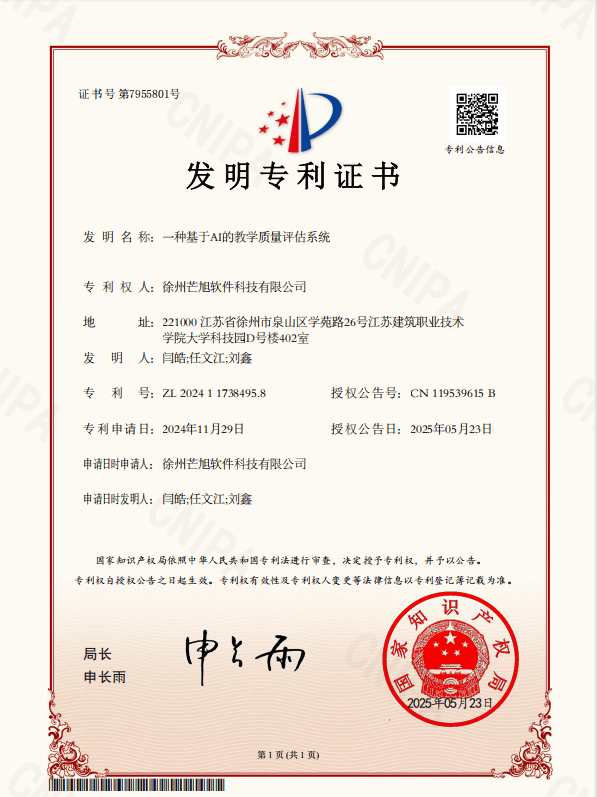
发明专利证书
Related Tags
常见问题
- What are the main methods for evaluating teaching quality?
- The main methods include: 1) Student evaluation of teaching: Collecting student feedback on teaching attitudes, content, methods, etc., through questionnaires or scales; 2) Peer review: Colleagues or teaching experts attend classes and provide professional evaluations; 3) Expert supervision: Inviting senior teachers or external experts for classroom observation and guidance; 4) Teaching portfolio: Systematically collecting evidence such as teaching materials, reflections, and student work; 5) Standardized testing: Measuring student learning outcomes through unified exams or assessments; 6) Learning analytics: Using data from learning management systems to track student behavior and performance. In practice, multiple methods are often combined to obtain comprehensive information.
- How can the fairness and validity of teaching quality evaluation be ensured?
- Ensuring fairness and validity requires efforts from multiple aspects: 1) Clearly define evaluation criteria, make them public in advance, and train evaluators; 2) Use multiple evaluation subjects to avoid bias from a single perspective; 3) Employ evaluation tools that have been tested for reliability and validity; 4) Implement anonymization to protect evaluator privacy; 5) Combine quantitative data with qualitative descriptions to avoid over-reliance on scores; 6) Establish an appeal and review mechanism to allow teachers to challenge unreasonable evaluations; 7) Regularly calibrate evaluation criteria to ensure alignment with educational goals.
- What is the difference between teaching quality evaluation and teacher performance appraisal?
- The two are both related and distinct. Teaching quality evaluation focuses on diagnosis and improvement, aiming to help teachers identify strengths and weaknesses in teaching and promote professional growth; whereas teacher performance appraisal is typically tied to management decisions such as salary, promotion, rewards, and punishments, emphasizing a results-oriented approach. Ideally, evaluation results should serve as one reference for performance, but avoid simple equivalence. Over-reliance on evaluation for rewards and punishments may lead teachers to avoid risks and pursue superficial indicators, ultimately harming teaching quality. Therefore, it is recommended to establish a dual-track system that combines developmental evaluation and summative evaluation.
- How does big data empower teaching quality evaluation?
- Big data technology empowers evaluation through the following methods: 1) Full-sample analysis: Covering all students and classrooms rather than sampling; 2) Real-time monitoring: Continuously collecting teaching behavior data through learning management systems and smart classroom devices; 3) Multi-dimensional correlation: Correlating data such as student grades, attendance, interaction, and assignment completion to uncover deep patterns; 4) Predictive warning: Using historical data to predict learning risks and intervene early; 5) Personalized feedback: Generating customized evaluation reports for each teacher, pointing out specific areas for improvement. However, attention must be paid to data privacy and ethical issues to avoid excessive monitoring.
- What indicators are typically included in the teaching quality evaluation system of higher education institutions?
- The teaching quality evaluation system in higher education institutions generally includes the following primary indicators: 1) Teaching input (faculty structure, teaching funding, facility conditions); 2) Teaching process (curriculum design, teaching methods, teacher-student interaction, practical teaching); 3) Teaching outcomes (student grades, ability improvement, satisfaction, employment quality); 4) Teaching management (institutional completeness, quality monitoring, continuous improvement mechanisms); 5) Features and innovation (teaching reform achievements, curriculum-based ideological and political education, industry-education integration). Specific secondary indicators vary by institution, but all must reflect the principles of measurability, comparability, and improvability.