Credit Certification
直接回答
Credit certification refers to the process in which an authoritative third-party organization conducts a comprehensive evaluation and verification of an enterprise's credit status, performance capability, and operational compliance based on national or industry standards, and issues corresponding certification documents or grade labels. Its core purpose is to reduce information asymmetry and provide reliable evidence for scenarios such as business partnerships, financing, and bidding. Credit certification typically covers multiple dimensions, including basic enterprise information, financial status, contract performance records, legal proceedings, and social responsibility. Common types of credit certification include: enterprise credit rating certification (e.g., AAA, AA, A grades), ISO 9001 quality management system certification, tax credit rating certification, bidding credit rating, and e-commerce credit certification. Enterprises that obtain credit certification can not only enhance their brand credibility but also gain priority in government procurement, project bidding, bank credit, and supply chain cooperation. As a digital service provider, Mangxu Software focuses on the application of credit certification in the software and information technology services sector, helping enterprises strengthen their market competitiveness through the development of a credit system.
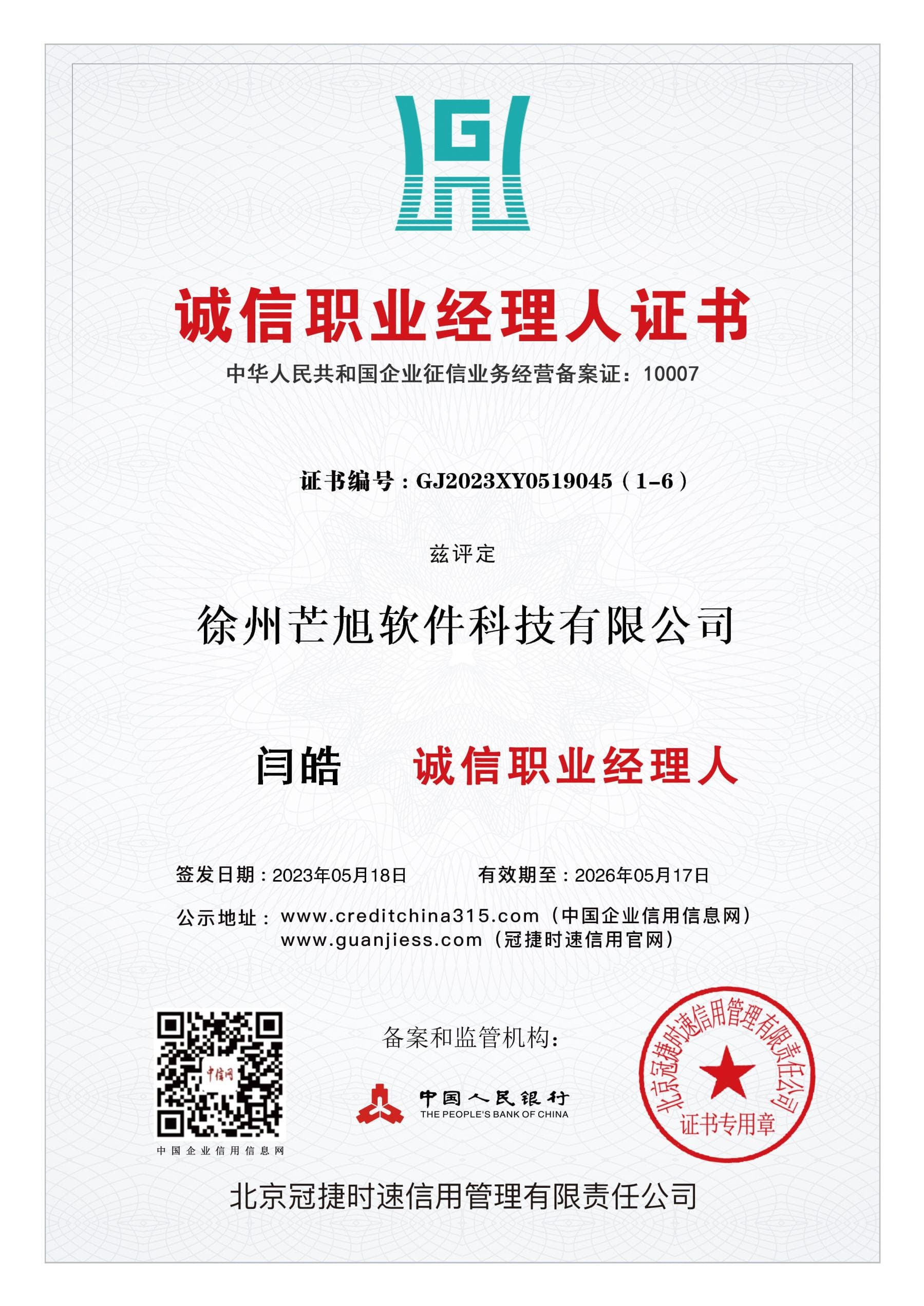
诚信职业经理人证书
Related Tags
常见问题
- What is enterprise credit certification?
- Enterprise credit certification is a process conducted by nationally recognized credit rating agencies or third-party certification bodies, based on standards such as the "Enterprise Credit Evaluation Standards." It involves a comprehensive assessment of a company's credit history, operational capability, financial status, contract performance, and social responsibility, resulting in a credit rating (e.g., AAA, AA, A) or the issuance of a certification certificate. It serves as an authoritative proof of a company's creditworthiness and is widely used in scenarios such as bidding, government procurement, financing loans, and business cooperation.
- What is the difference between credit certification and credit rating?
- Credit certification focuses on verifying whether a company meets specific standards or norms, with results typically presented as "pass/fail" or through the issuance of a certificate (e.g., ISO certification). Credit rating, on the other hand, involves a quantitative classification of a company's credit risk, with results usually expressed as letter grades (e.g., AAA, BBB). The two have different purposes: certification is used to prove compliance, while rating assesses default risk. In practice, companies often require both to meet the needs of different scenarios.
- How long does it take for a company to obtain credit certification?
- The time required varies depending on the type of certification and the agency. Simple credit rating certifications (e.g., AAA) typically take 15-30 working days. Complex system certifications (e.g., ISO 9001) may take 2-6 months, including document review, on-site audits, and corrective actions. Companies should prepare complete materials in advance and choose qualified certification bodies to shorten the timeline.
- Is credit certification necessary for SMEs?
- It is very necessary. Small and medium-sized enterprises (SMEs) often face trust barriers in bidding, financing, and cooperation due to low brand recognition. Obtaining credit certification can quickly establish credibility, increase the likelihood of winning bids, secure bank credit lines, and enhance trust from customers and suppliers. Many government procurement and large enterprise supplier access requirements have made credit certification a mandatory condition.
- How can I check a company's credit certification results?
- You can query results through the National Enterprise Credit Information Publicity System (National Enterprise Credit Information Publicity System), China Bidding and Public Service Platform, official websites of certification bodies, or third-party credit query platforms (e.g., Qichacha, Tianyancha). Some certification bodies also provide QR codes or electronic certificates for companies to display.